For SHA-256 vs MD5 for file verification, choose SHA-256 when a download page provides both. MD5 can still reveal accidental transfer errors in a non-adversarial setting, but it should not be relied on when someone might deliberately manipulate the input. SHA-256 is the appropriate choice for a security-relevant comparison.
The algorithm is only part of the decision. A sound SHA-256 vs MD5 comparison also needs a reference digest that you trust. A matching value shows consistency with that reference under the selected algorithm. It does not, by itself, prove who published the file or whether the file is harmless.
SHA-256 vs MD5 for file verification at a glance
Both algorithms turn file bytes into a fixed-length digest. If you need the underlying terminology first, read what a file checksum means. For an SHA-256 vs MD5 choice, the important differences are output size and collision resistance.
| Question | MD5 | SHA-256 |
|---|---|---|
| Digest size | 128 bits | 256 bits |
| Usual hexadecimal display | 32 characters | 64 characters |
| Collision-resistance position | Not acceptable when collision resistance is required | Part of NIST’s approved SHA-2 family |
| Suitable file-verification role | Accidental-error detection in a non-adversarial context | Preferred when verification has a security purpose |
Display length alone is not a complete measure of security. Each hexadecimal digit represents four bits, which explains the 32-character and 64-character forms. The reason to prefer SHA-256 is not the slogan that it is “twice as secure.” The relevant distinction is that published collision attacks have made MD5 unsuitable where collision resistance matters, while NIST permits SHA-2 functions for applications that use secure hash algorithms.
Why MD5 collision weakness changes the decision
A collision occurs when two different inputs produce the same digest. Collision resistance matters when an adversary may be able to prepare or substitute content. RFC 6151 says MD5 is no longer acceptable where collision resistance is required.
That conclusion should not be stretched into a different claim. A demonstrated collision method is not the same task as taking one arbitrary, fixed file and producing another file with that file’s existing digest. Saying that MD5’s collision resistance is broken is accurate. Saying that any chosen file can instantly be made to match any chosen MD5 value is not. RFC 4270 explains the distinction between collision, preimage, and second-preimage resistance.
The threat model matters in any SHA-256 vs MD5 decision. A digest used only to notice an accidental transmission error has a narrower job than a digest used where deliberate tampering is possible. Software may still offer MD5 for legacy compatibility, but availability does not make it the better security choice.
When an MD5 checksum can still tell you something
SHA-256 vs MD5 is not a choice between useful and useless. RFC 6151 retains a narrow role for MD5 when the digest is used solely to protect against accidental errors. If a transfer changes unexpectedly and the calculated MD5 differs from the expected MD5, the values tell you that the bytes are not the same.
That limited usefulness does not restore collision resistance. It means the verifier has decided that hostile input construction is outside the situation being considered. GNU’s md5sum manual page makes the same practical boundary clear by warning against MD5 for security-related purposes. Microsoft likewise describes MD5 and SHA-1 as options for simple change validation rather than for files that need protection from attack or tampering in its Get-FileHash guidance.
In an SHA-256 vs MD5 comparison, the source of the reference matters as much as the algorithm name. If only MD5 is published and the download matters from a security perspective, ask the provider for SHA-256 or use a verifiable digital signature supplied through an appropriate trust path. Calculating SHA-256 from the downloaded file alone does not create a trusted expected value. It only creates a baseline for that copy.
What a SHA-256 match does and does not prove
SHA-256 produces a 256-bit digest and belongs to the SHA-2 family. NIST lists SHA-2 among its approved hash algorithms on its hash functions overview. Its hash-function policy allows SHA-2 for applications employing secure hashes and encourages SHA-256 at minimum where interoperability is required. The FIPS 180-4 landing page records the standard’s status and planned revision, while the FIPS 180-4 standard specifies SHA-256 and notes that conformance alone does not assure implementation security.
The practical SHA-256 vs MD5 difference is clearest when deliberate substitution is possible. A full SHA-256 match means the calculated digest is consistent with the expected SHA-256 digest. The expected value still needs a trustworthy route to you. If an attacker can replace both a file and the digest displayed beside it, a matching unkeyed hash does not independently establish publisher identity or origin.
A match also is not a malware scan. It can confirm that you received the same bytes represented by the reference, even if those bytes contain something unwanted. The Filekub ransomware guide covers a separate security concern. Signatures, trusted digest distribution, and malware analysis answer questions that a bare checksum comparison does not.
What to choose on a download page
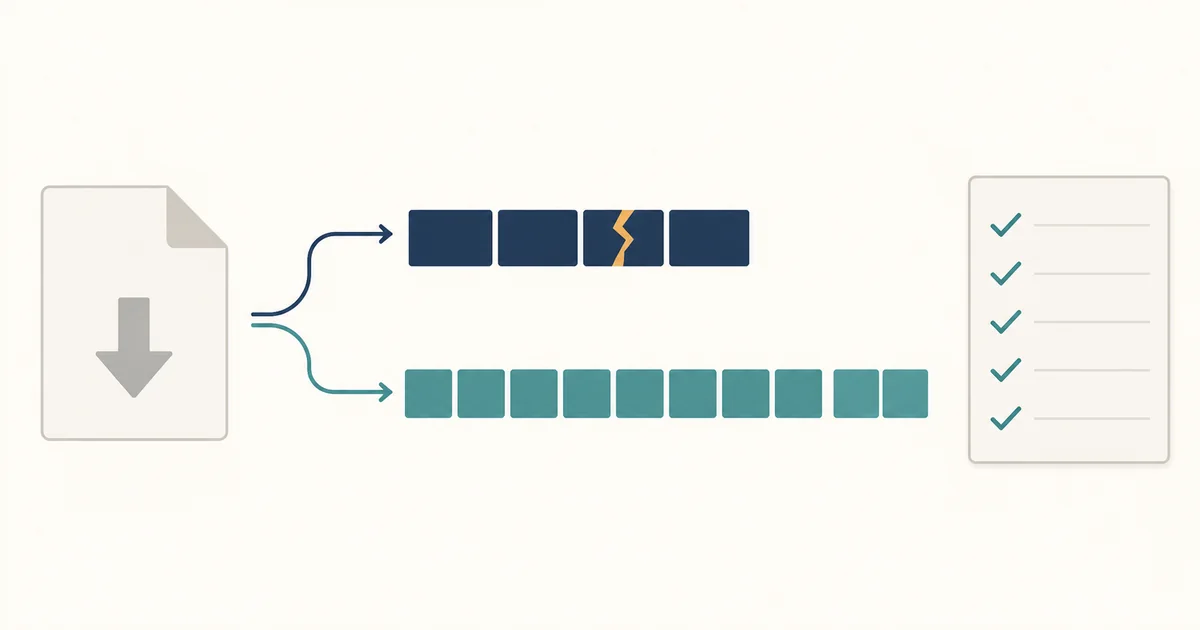
- Both MD5 and SHA-256 are offered: choose SHA-256. Calculate SHA-256 and compare it with the published SHA-256 value.
- Only SHA-256 is offered: compare the complete digest. Follow the dedicated guide to verify a download with SHA-256 for the calculation and comparison workflow.
- Only MD5 is offered: treat it as an accidental-error check, not a collision-resistant anti-tampering check. Seek a provider-published SHA-256 value or a verifiable signature when security matters.
- No digest is offered: use the provider or platform’s signature-verification mechanism when available, or obtain a reference through a source you trust.
An SHA-256 vs MD5 check must compare like with like. Never compare the MD5 string with the SHA-256 string because they are outputs from different algorithms and have different lengths. Verify like with like, and compare the complete value rather than a short visual sample.
Frequently asked questions
Is MD5 safe for file verification?
In an SHA-256 vs MD5 decision, MD5 can detect accidental errors in a non-adversarial context, but it is not suitable when collision resistance is required. Use SHA-256 when file verification has a security purpose and both options are available.
Is SHA-256 encryption?
No. SHA-256 is a one-way hash algorithm. It produces a digest for comparison; it does not encrypt a file or provide a decryption key.
Does a SHA-256 match mean a file is safe?
No. It means the digest is consistent with the reference value under SHA-256. Safety, publisher identity, and the trustworthiness of the reference are separate questions.
Is SHA-256 the same as SHA-2?
SHA-256 is one hash function in the SHA-2 family. The GNU Coreutils SHA-2 utilities documentation lists tools for SHA-224, SHA-256, SHA-384, and SHA-512 digests.
After making the SHA-256 vs MD5 choice, open the Filekub checksum calculator, calculate the named digest, and compare it with the trusted reference. For your next file workflow, visit Filekub.